
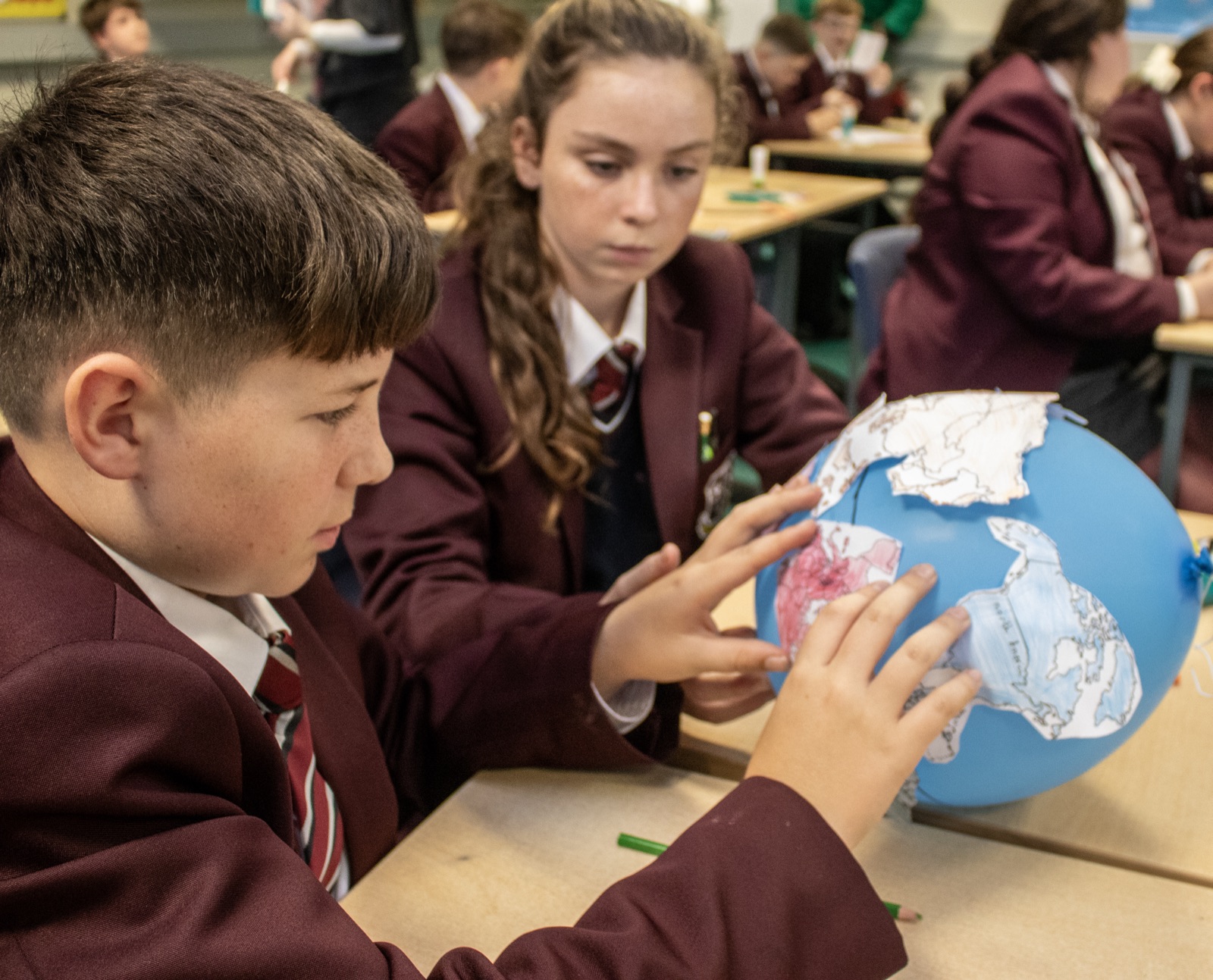
Geography is offered throughout the St Paul’s curriculum, from Year 8 to Year 14. In Year 8 it is taught with History as Environment and Society; it continues through Key Stage 3 to Year 10, then at GCSE in Years 11 and 12 and at A Level in Years 13 and 14.
At Key Stage 3: Years 8 to 10
Environment and Society is the name given to the two subject areas of History and Geography. In Year 8, Geography is combined with History in one subject, Environment and Society. The Geography topics and skills include:
- Geographical skills: latitude and longitude, continents and oceans, and map skills
- Classification of geographical features: human and physical features and identification
- Graphs and enquiry skills: collecting primary data, constructing graphs, and analysing and interpreting data
- My Identity Project: research and managing information about family and place
- Settlement: patterns, the process of urbanisation, and hierarchies
More about Year 8 Geography within Environment and Society on stpauls728.org
At GCSE: Years 11 and 12
GCSE Geography
Physical Geography (Unit 1) is taught in Year 11, with its examination in the summer term. In Year 12 pupils study Human Geography (Unit 2) and prepare for the fieldwork paper (Unit 3): they collect and table their own data, and bring it into the examination with a fieldwork statement.
How it is assessed
- Unit 1: Understanding Our Natural World: 1 hour 30 minute paper (40%)
- Unit 2: Living in Our World: 1 hour 30 minute paper (40%)
- Unit 3: Fieldwork: 1 hour paper (20%)
Units
- Unit 1: River Environments; Coastal Environments; Our Changing Weather and Climate; The Restless Earth
- Unit 2: Population and Migration; Changing Urban Areas; Contrasts in World Development; Managing our Environment
What helps you succeed
- Gathering and analysing different kinds of data
- Planning and managing research
- Working as part of a team
- Spatial, social and environmental awareness
- Problem solving and decision making
- Interest in cultures and places
Where it leads
Planning, environmental and sustainability projects, water analysis, ecotourism, climate change, geographical information systems, pollution analysis, risk assessment, refugee advice and water supply.
From the KS4 Subject Choice Booklet 2027.
At A Level: Years 13 and 14
GCE Geography
The course gives pupils the knowledge and skills to be independent, successful geographers in a rapidly changing world. It reflects the subject’s many disciplines, and its skills improve employability across the physical and natural sciences. Pupils consider their own attitudes, and those of others, to the world around them.
Units
- AS 1: Physical Geography: Rivers, Global Biomes, and Weather and Climate: 1 hour 15 minutes (40% of AS; 16% of A Level)
- AS 2: Human Geography: Population, Settlement and Development: 1 hour 15 minutes (40% of AS; 16% of A Level)
- AS 3: Fieldwork Skills and Techniques: 1 hour (20% of AS; 8% of A Level)
- A2 1: Physical Geography: Plate Tectonics and Ecosystems: 1 hour 30 minutes (24% of A Level)
- A2 2: Human Geography: Cultural Geography and Tourism: 1 hour 30 minutes (24% of A Level)
- A2 3: Decision-Making in Geography: a compulsory case study exercise, 1 hour 30 minutes (12% of A Level)
What helps you succeed
An inquisitive mind, a strong work ethic, a desire to succeed, and sound English, as essay writing is required.
Where it leads
Teaching, town planning, planning and development surveying, environmental consultancy, geographical information systems and cartography, among many others.
The department
- Mrs M McConnellHead of Department
- Mr D McKennaAssistant Head of Geography
- Mrs Á Kelly
- Mr J McElroy
From the school’s Key Stage 4 Subject Choice 2027 and Post 16 Subject Choice 2026 booklets.